
RBI Repo Rate Hike to 5.50%: What It Means for Your Home Loan, EMI & Borrowing Plans
Recent Articles


Why Young People Are Buying Gadgets on EMI—Is It Really Worth It?
September 28, 2026

Can AI Decide Whether You Get a Loan? The Future of Lending in India
September 21, 2026

The borrowing environment in India has changed again.
On 7 October 2026, the Reserve Bank of India (RBI) increased the repo rate by 25 basis points, from 5.25% to 5.50%, the first repo rate hike in nearly four years. More importantly for borrowers, the RBI has shifted its policy stance from “neutral” to “calibrated tightening.”
For a person who is looking to make any significant purchase like buying a house, a car, or gold this festive season, the number here is much more than a figure in a financial news item.
It could eventually affect borrowing costs.
And when borrowing costs increase, even a slight rise in EMI can create problems for a family’s finances.
So, what does the latest RBI repo rate hike actually mean for you?
First, What Is the Repo Rate?
The repo rate is the rate at which the RBI lends money to commercial banks against eligible securities.
When the RBI changes this rate, it can influence the cost at which banks and financial institutions raise funds. Over a period of time, this might have ramifications on the lending rates on home loans, car loans, loans against properties, and even other floating rate loans.
Why Has the RBI Increased the Repo Rate?
The latest decision comes against a backdrop of increasing inflationary and external pressures.
The key factors include:
- Rising inflation
The retail inflation rate has been exceeding the 4% mid-term objective set by the RBI and making it difficult for the monetary policy to be put into effect. The figure for the retail inflation rates during the month of August of 2026 was 4.82%, and it has exceeded its target for the third month in a row.
- Higher global crude oil prices
India imports a significant portion of its crude oil requirements. When international crude prices rise, it can increase costs across transportation, energy, and several parts of the economy.
- A weaker rupee
If the rupee remains weak, imports might become costlier. Specifically, crude oil will thus become more expensive. If we add all these factors together, the situation becomes more complicated since the rupee keeps on being under pressure throughout 2026.
- Strong economic growth
Interestingly, India’s growth story remains relatively strong.
The RBI has raised its FY27 GDP growth forecast to 7.1% from 6.7%, giving policymakers more room to focus on inflation without compromising the growth outlook as aggressively as they might during an economic slowdown.
The inflation projection, meanwhile, has also been raised to 5.2% for FY27.
The message is clear:
Growth is strong. Inflation is the bigger concern.
That is why the RBI is choosing tighter monetary policy.
What Does “Calibrated Tightening” Mean?
This shift in terminology is significant.
The Reserve Bank of India has shifted from a ‘neutral’ position to ‘calibrated tightening.’
This implies that the Reserve Bank of India has changed its philosophy and that it is now willing to take steps to manage inflation and keep it from becoming entrenched.
While this does not necessarily mean that interest rates will increase at each monetary policy meeting, it indicates that individuals looking to borrow should not structure their plans on the assumption of borrowing becoming cheaper in the near future.
There are already discussions in the stock market and financial circles on how likely another increase may take place based on inflation, crude oil prices, currency developments, and international events.
For borrowers, the practical takeaway is simple:
Plan your loan assuming that borrowing costs may remain higher for some time.
How Will This Affect Your Home Loan EMI?
This is where the repo rate becomes personal.
Suppose you are taking a floating-rate home loan. If your lender passes on the increase through your applicable lending rate, your borrowing cost could rise.
The impact could come through:
- An increase in the EMI
- An increased duration of the loan
- A large amount of interest incurred in repaying the loan
- A lessened degree of financial leverage
- A shift in the affordable figure
The exact impact on a person would depend on personal circumstances.
Let’s take a hypothetical example of a 50 lakh rupee home loan that lasts for 20 years.
An increase in the interest rate may not seem too significant relative to the percentage.
However, over the long term, even a small variation in interest can have a significantly big impact on total payment.
That’s why borrowers should avoid concentrating on just the main interest rate.
They should compare:
Interest rate + EMI + tenure + processing charges + reset mechanism + total interest payable.
This is also where professional loan comparison can make a difference.
COVID Taught Us Something Important About Interest Rates
There is an interesting lesson from the COVID period.
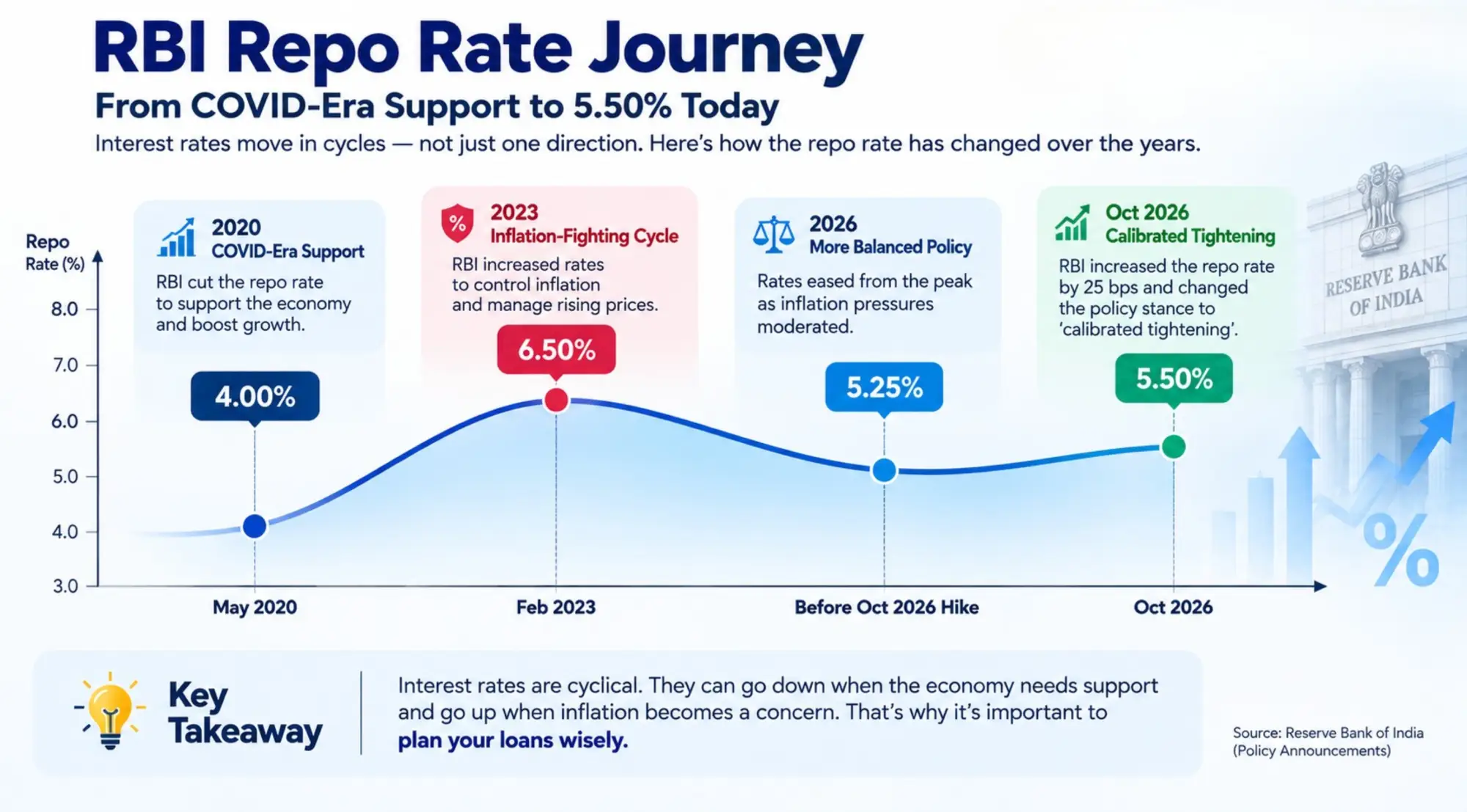
During the pandemic, the RBI aggressively reduced the repo rate to support economic activity. In May 2020, the RBI reduced the repo rate to 4.00%, while maintaining an accommodative stance to support growth and mitigate the economic impact of COVID-19.
The RBI later maintained the repo rate at 4.00% through much of the pandemic recovery period.
How India’s Repo Rate Has Changed Over the Years
From COVID-era support to today’s calibrated tightening, the repo-rate journey shows how monetary policy can change with the economy.
This ultra-low-rate environment helped create an attractive borrowing environment, with home-loan interest rates in the market reaching historically low levels, including offers around the 6.25% range for eligible borrowers.
However, there is a significant takeaway here:
The rates of interest observe cycles.
Meanwhile,
The Reserve Bank of India, which slashes rates when the economy has to be revived, raises them when inflation comes into the picture.
For illustration, the repo rate touched a peak of 6.50% in February 2023 after a series of hikes starting in 2022.
Rate Cycle: The Bigger Picture
| Period | RBI Repo Rate | What It Signalled |
|---|---|---|
| COVID period, 2020 | 4.00% | Support growth & recovery. |
| Feb-23 | 6.50% | Fight inflation. |
| Before the latest hike, 2026 | 5.25% | More balanced policy |
| Oct-26 | 5.50% | Calibrated tightening |
The lesson is not to wait endlessly for the “perfect” rate.
The lesson is to understand your own affordability and choose the right borrowing structure.
Why This Matters During the Festive Season
The timing of the hike in interest rates has special significance.
India is now entering a time when people have a greater passion to buy houses, cars, two-wheelers, gold, and other major purchases quite commonly.
Traditionally, consumers plan their purchases according to:
- Festival offers
- Bonus payments
- New launches of vehicles
- Real estate transactions
- Weddings
- Gold buying
- Year-end planning
However, this year, borrowers should also take into account the possibility of higher borrowing costs.
But if the financing cost is higher, the total cost of ownership can still change.
That is why the smartest question is not
“How much loan can I get?”
It is:
“How much loan can I comfortably afford?”
Should You Delay Your Home Purchase?
Not necessarily.
A rate hike does not automatically mean that you should postpone buying a home.
Property decisions involve several factors beyond interest rates, property prices, location, income stability, down payment, taxation, rent, future requirements, and your long-term financial goals.
And importantly, monetary policy can change again in the future.
However, borrowers should avoid making a major financial decision based on the assumption that rates will definitely fall soon.
If you have found the right property and your finances are comfortable, the better approach may be to compare lenders carefully, negotiate the loan terms, and understand the future EMI impact before committing.
Actions Borrowers Should Take
Borrowers can undertake five actions when it comes to repossession rates.
- Check various lenders.
Your first offer may not be the best offer.
- Look past the advertised interest rate.
Don’t forget to investigate additional cost components such as processing fee, legal charges, insurance requirements, resetting frequency, etc.
- Keep some margin for EMIs.
Your budget should leave you with some room in case borrowing costs increase.
- Choose the right tenure.
A longer tenure leads to lower EMI but higher aggregate interest payment.
- Seek professional help.
A loan is a long-term commitment, and you may save more money if you explore your options before signing instead of hunting for a few bucks of short-term benefit.
A loan is a long-term commitment, and you may save more money if you explore your options before signing instead of hunting for a few bucks of short-term benefit.
The Good News: Rate Cycles Don’t Last Forever
The current environment may feel challenging for borrowers, but it is important not to panic.
Interest rates are cyclical.
During COVID, monetary policy moved aggressively towards lower rates to support the economy. Later, rates increased sharply when inflation became the priority.
Today, the RBI is once again moving towards tighter policy because inflationary risks have increased.
That does not mean rates will keep rising forever.
This means that those borrowing should be proactive rather than waiting for things to happen.
Don’t forget that the Reserve Bank of India doesn’t alter rates merely to increase borrowing costs. The purpose of monetary policy is to maintain a balance between inflation, growth, and economic stability.
Frequently Asked Questions
1. What is the RBI repo rate?
The repo rate is the rate at which the Reserve Bank of India lends money to commercial banks against eligible securities. Changes in the repo rate can influence borrowing and lending conditions across the economy.
2. What is the current RBI repo rate?
The RBI has raised the repo rate from 5.25% to 5.50% in October 2026, alongside a shift in its policy stance to “calibrated tightening.”
3. Will the repo rate hike increase my home loan EMI?
It can, particularly if you have a floating-rate loan and your lender passes the increase through to your applicable lending rate. The actual impact depends on your lender, benchmark, outstanding loan amount, tenure, and rate-reset mechanism.
4. Should I delay buying a home because of the repo rate hike?
Not necessarily. Interest rates are only one part of a home-buying decision. Your income stability, down payment, property price, affordability, and long-term financial goals should also be considered.
5. Why did the RBI increase the repo rate?
The latest hike is linked to concerns including higher retail inflation, elevated global crude oil prices, and pressure on the Indian rupee. The RBI is using tighter monetary policy to help manage inflationary pressures.
6. Can home loan interest rates come down again?
Yes. Interest rates can move in either direction depending on inflation, economic growth, liquidity, and other domestic and global conditions. However, borrowers should not assume that rates will fall in the near term.
Final Word: Don’t Just Borrow More. Borrow Smarter.
The repo rate has moved from 5.25% to 5.50%, and the RBI’s shift towards calibrated tightening tells borrowers that the era of assuming continuously cheaper credit may be over—at least for now.
But a 25-basis-point hike should not stop genuine financial goals.
It should encourage better financial planning.
Whether you are planning a home, car, gold purchase, or another major financial commitment, compare your options before making a decision.
At Loan Bazaar, individuals have the option to review loan products available from banks and financial institutions and make a sensible borrowing choice. The purpose is not just obtaining approval for a loan; however, it is to obtain the best loan that will benefit the borrower’s finances.
A Word of Caution for New Homebuyers
If you have selected a property and are about to purchase it, don’t base your decision only on the maximum loan amount or maximum tenure you are eligible for. A longer tenure may reduce your monthly EMI, but it can significantly increase the total interest paid over the life of the loan.
Before finalizing the property, check whether the EMI remains comfortable even if borrowing costs rise in the future, and leave enough room in your monthly budget for other financial commitments.
Comments